AI doesn't break TARA. It makes two kinds of assumptions more expensive to get wrong.
1. Two Patch Speeds
In 2015, I found a hole in a carmaker's cloud service: anyone who knew an owner's email address could unlock their car remotely and control a few cabin and engine functions. I reported it, and the manufacturer fixed it quickly and quietly, with no bulletin and no CVE. So back then, when carmakers' cloud services were still new, you could already interfere with someone's life without leaving your room. (Not to mention Charlie Miller and Chris Valasek's famous remote Jeep hack that same year, which at the time really was rocket science.) A hole like mine, though, could be closed with one server patch for the whole fleet, without anyone outside ever knowing.
A couple of years ago, Sam Curry and Shubham Shah found a similar style hole in Subaru's cloud. By taking over an employee account in an admin portal, they could find almost any connected Subaru in the US, Canada, and Japan by its owner's last name and ZIP code, email, phone, or license plate. Then they could unlock it, start it, and pull up a year of its location history. Subaru fixed the hole in about 16 hours.
Both stories show the problem and the luck of automotive security. The problem is visibility. In this field, holes are hunted less, reported less, and rarely end up as CVEs. The systems themselves are harder to see into, so we know little about which threats actually play out. The luck is that cars seem to be attacked less, probably because they have always been a harder target. Most often, an attacker needs either a car or an activated account linked to one, and such an account is usually hard to get without a car. That doesn't make attacks impossible, and it doesn't mean the vulnerabilities aren't there or that nobody exploits them. But an attack costs more, and an attacker can usually find a more rewarding target elsewhere.
For car theft, at least, the luck has an economic logic. Much of the money in attacking cars today seems to be in theft, and for a thief a cloud hole is a poor investment. Starting a car remotely is not driving it away, and one patch makes the hole worthless overnight. A hole in the car itself lives for years, because the fix must reach every vehicle. When Kia and Hyundai had to patch cars without immobilizers, only about 40% of eligible cars had the fix almost two years later. That is sixteen hours for a whole fleet, against 40% of cars after two years.
These are the two races from my previous article, “The Vulnpocalypse Is a Race”: the race to find a vulnerability and the race to patch it. Patching means both fixing and delivering. In the cloud, the two are one action, but in cars they are not. In that article I also compared vulnerabilities to lightning and breaches to forest fires. How much burns depends on the forest. A carmaker has several forests, but the two that matter here are the cloud and the cars, and Subaru and Kia differ not because one does a better job, but because different forests were burning.
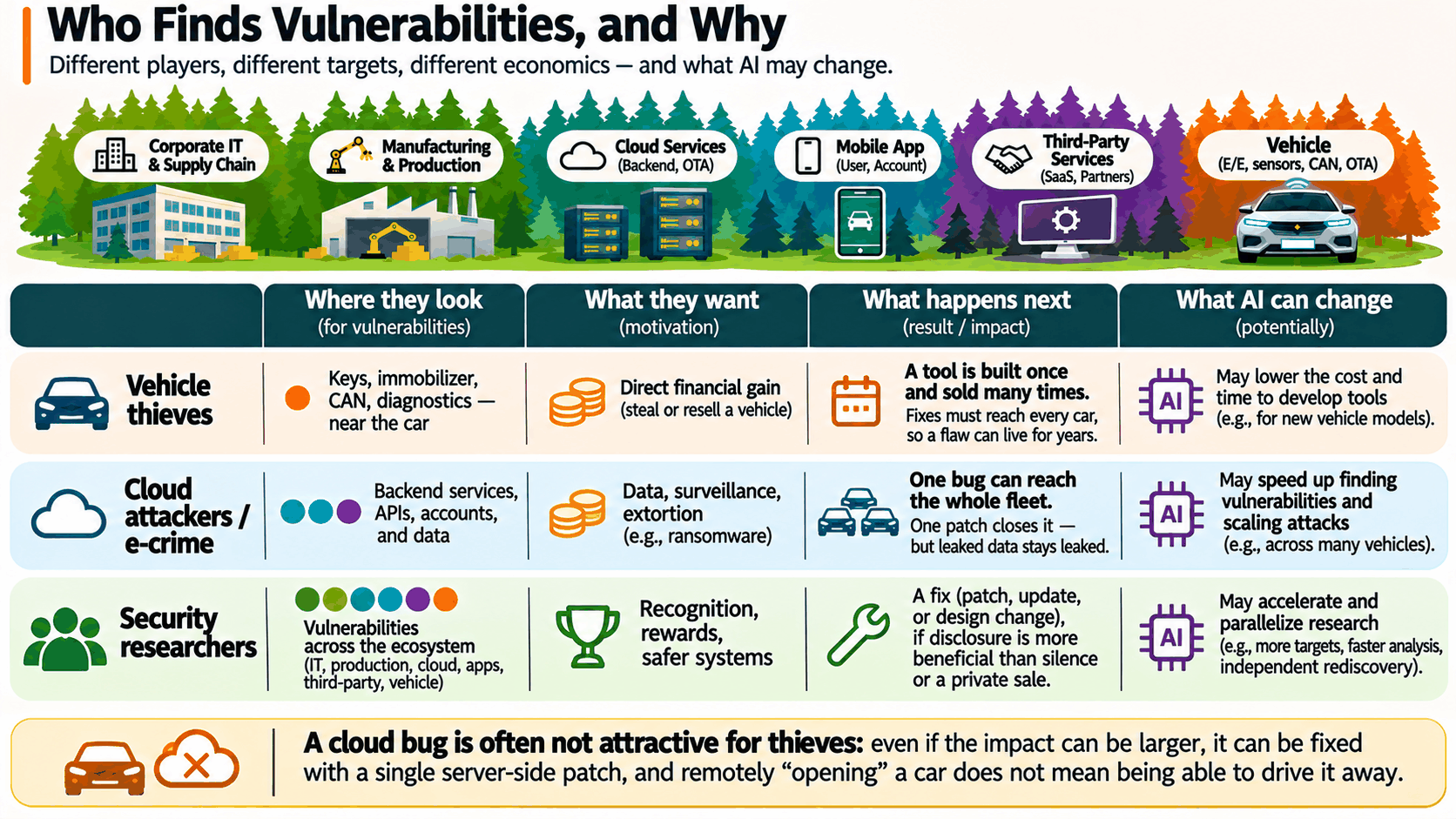
Three kinds of vulnerability economics, and two patch speeds. The AI column shows possible shifts, not measurements.
Now AI enters the picture. Attackers upgrade their capabilities almost continuously, while cars, their architecture, and our risk assessments change slowly. TARA is the industry's main risk assessment tool, and I don't think AI breaks it. Its weaknesses were there before AI. Assessments are subjective, the analysis is often split between teams, and decisions are made years ahead. But modern vehicle architecture multiplies attack paths, and AI makes assessments age faster. Together, they bring two assumptions to the center: that a neighboring system is secure, and that an attack is as costly as we think. That is what this article is about.
2. TARA Looks at the Forest
The industry did prepare for such fires. For vehicles, there is the ISO/SAE 21434 standard, and UN R155 makes cybersecurity management mandatory for the type approval of new vehicles in the EU and several other countries. At the core of ISO/SAE 21434 is TARA, threat analysis and risk assessment.
I think TARA is a very good tool. It starts from threats, not from a checklist, and makes the defender picture exactly how an attack unfolds. It has two halves. The first is impact: who gets hurt and what they lose in safety, money, vehicle operation, and privacy. The second is attack feasibility: how hard the attack is and what skills and equipment it takes. In the previous article's terms, impact is the forest, and feasibility is how easily lightning turns into fire.
But the result depends on who does the assessing. I once asked several security specialists to take the same item and name its top three threats. No two lists were alike, and the differences went deeper than the threats themselves, down to what counts as a threat at all. People mixed up damage scenarios with their consequences, and threat scenarios with attack paths. And that is the very foundation of TARA, the steps everything else is built on. I'm not the only one who sees problems here: researchers who interviewed 15 automotive cybersecurity experts report that the TARA process is often highly inefficient.
TARA assesses an item: a system that implements a vehicle function, together with its boundary and the assumptions about what lies beyond it. That works well for ECUs, but the car is becoming a mobile app on wheels. You think you are protecting the ECU, and you get hacked through a web server in the cloud.
3. Where the Door Actually Opens
In both my 2015 story and Subaru's, it wasn't the car that decided to open the door. It was the cloud, which checked who was asking and sent the command, whatever safeguards the car had on its side. So the attack path ran through the web service's authentication and logic, not through the CAN bus or the lock firmware. More and more functions work this way, including remote unlock and start, phone keys, trip history, and over-the-air updates.
On paper, the cloud isn't forgotten, because UN R155 requires the risk assessment to consider interactions with external systems. But the regulation prescribes no method, and the TARA most often used to meet it focuses on on-board systems.
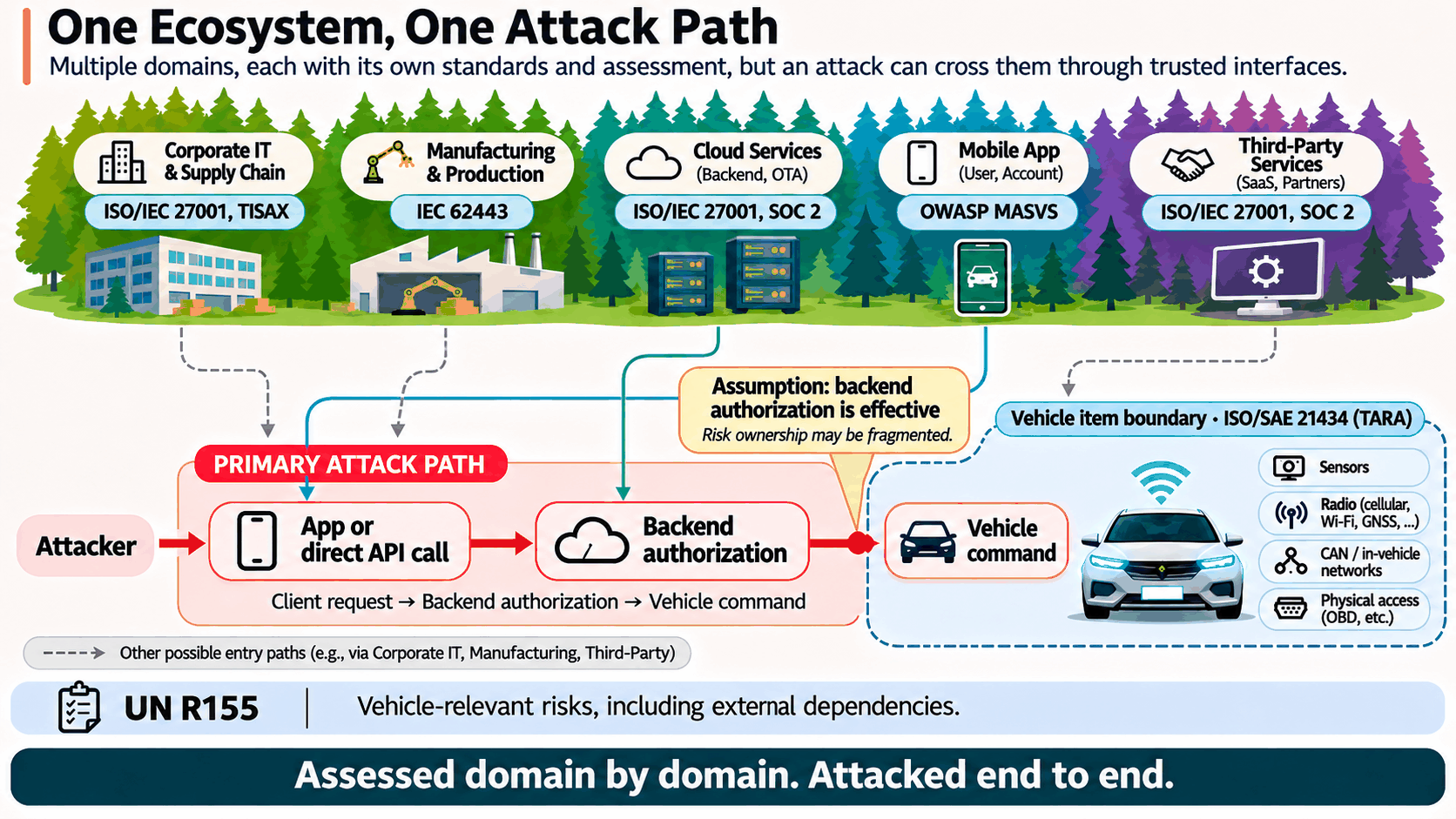
The decision to “open” is made in the cloud. Domains may be assessed separately, even when one attack path crosses their boundaries and rests on a shared assumption.
Some teams already do end-to-end analysis. In my experience, though, the item more often ends at the vehicle perimeter, and everything beyond it becomes assumptions: “the backend is secure,” “the app checks that the owner sent the command.” An assumption is a fine tool, as long as it is written down and someone checks it. But if the cloud decides whether the door opens, both the impact and people's physical safety depend on that assumption. It is then no longer just a boundary of the analysis but part of the risk. To the long-running debate over component-based versus function-based TARA, I'd add one thing: a function doesn't end at the vehicle perimeter.
The cloud is also where AI may help an attacker most, because web servers and APIs are the kind of code AI tools are already used to analyze. The backend gets tested too, of course, but often by another team and as an ordinary web service. Correct local assessments don't necessarily add up to a correct whole, and the path from phone to lock can end up with no single risk owner. Fraunhofer AISEC sees something similar: of six carmakers whose security staff it interviewed, only four reported any form of cross-divisional cybersecurity strategy.
Cariad, Volkswagen's software subsidiary, shows what is at stake. In late 2024, the Chaos Computer Club found data on almost 800,000 electric vehicles in misconfigured cloud storage, with precise location histories for about 466,000 of them. These included politicians' cars and police vehicles. No evidence of outside access was found. Still, this is exactly the impact TARA starts with, the privacy and safety of specific people. The only difference is that the data lived outside the car.
That is the first assumption: that the neighboring system is secure. The second is about the attacker.
4. Expertise Ages Faster Than the Car
The standard offers a detailed method for rating feasibility, called attack potential. It combines five factors: elapsed time, expertise, knowledge of the item, window of opportunity, and equipment. By my estimate, AI shifts them unevenly. It can cut the time and the expertise an attack takes, and it helps an attacker learn the item from its firmware, protocols, and APIs. But it barely changes the window of opportunity or the equipment, which depend on access and hardware. For attacks that need physical access, someone still has to get to the car with a device. For a remote attack on a cloud service, both factors are usually at their least restrictive anyway.
For TARA, the awkward factor is expertise, because its shift is the hardest to notice. The PlayStation 5 shows what this can look like. A console is not a car, and its threat model is different: a hack hurts Sony first, and many owners actually want their console hacked. But like an ECU, a console is a closed platform, and the question is the same: how hard is it to find a vulnerability there?
Andy Nguyen, one of the best-known console researchers, says he had found a PS5 hypervisor bug a while ago and was holding it back. In September 2026, another hacker claimed to have found the same bug with an LLM, and said others had got there too, also with AI. “If I and another person can find it with LLM, so can someone else,” he said, as Tom's Hardware reported. He then took the bug to Sony, and Nguyen announced he was stepping away from the PS5 scene. The AI part rests on the hackers' own word, but either way, none of them could count on keeping a difficult find secret for long.
Now carry this over to the car. Suppose a manufacturer rated the feasibility of compromising a protected ECU as low, because the attack chain needs rare reverse-engineering skills. Based on that rating, it accepted the residual risk and didn't further limit what a compromised unit can do, such as which commands it may send to other units. If those skills become more accessible, the decision needs reassessing, even though the car hasn't changed, no new vulnerability has appeared, and no new hacking tool has been released.
The standard already requires continuous monitoring and reassessment, but growing AI capability may produce no obvious trigger. A new vulnerability, an incident, or a vehicle update sends you back to TARA. When yesterday's expert work becomes doable by a mid-level specialist, there is no such event to mark the moment. The expertise scale was designed to tell attackers apart, and it tells them apart less and less. Meanwhile, the car stays on the road for 10–15 years.
5. Planning for Wrong Assumptions
The simplest response to this uncertainty is to play it safe and rate every remote path as highly feasible, but if everything is high, nothing is a priority.
Doing it properly, though, can turn TARA into a monster. The matrix grows, attack paths reach into the cloud and the phone, and assessments need revising on the fly. It all rests on people who understand threats to the car, the cloud, and mobile apps at once, and there are few such people. With this many threats, this much attack surface, and attacks that cross every boundary, no team can manage it all by hand. My bet is that AI will have to carry part of that load for defenders, with people checking what it produces, and that defenders need it before attackers get the same edge.
Instead of playing it safe, it is more useful to rely on what the manufacturer can measure and control itself. I see seven practical steps. The first three keep the assumptions honest. The other four limit the damage when they turn out wrong.
- Give assumptions about neighboring systems an owner. Analyze each cloud-reachable function end to end, from the phone through the cloud to the ECU, and give that path one risk owner. Turn backend assumptions into verifiable requirements. A simple test: can you name the one person responsible for the path from the button in the app to the door lock?
- Stress-test assumptions about the attacker. Re-rate accepted risks with expertise and elapsed time one level lower, and see which treatment decisions flip. Those risks rest on attackers staying rare. Back them with measures that work regardless of the attacker's skill, like the ones in step 4. This needs no forecast of AI progress.
- Keep TARA alive. UN R155 already requires keeping the risk assessment current. Since AI progress brings no obvious trigger, create one. Feed threat intelligence into TARA, including signs that attacker capability is shifting, such as AI-found bugs in similar closed platforms. Re-rate feasibility on a fixed schedule, not only after an incident. TARA should show how risks change over time, not just how they looked at type approval.
- Limit scale by architecture. What matters is not only who may send a remote command, but also how many cars one account can send it to. At Subaru, one hijacked employee account could open almost any car. So narrow what a single account or service can reach, require extra authorization for dangerous commands, and monitor commands sent at scale. Inside the car, limit which commands a compromised unit may send to others, so that a low feasibility rating isn't the only thing between one ECU and the rest.
- Use the same tools. Carmakers and their suppliers should put AI to work in TARA itself, in code review, and in vulnerability analysis of their own firmware, backends, and apps. Let it trace attack paths across the car, the cloud, and the phone, and check the analysis for the kind of confusion my experiment showed. Defenders have what attackers lack: the source code and the documentation.
- Make disclosure pay better than silence. If several people can now find the same bug, what they do with it matters. Carmakers already run bug bounty programs, but reporting a find has to beat sitting on it or selling it.
- Measure fleet patch coverage. The metric is not “a fix was released” but the share of cars actually protected after 7, 30, and 90 days, tracked separately for cloud fixes, over-the-air updates, and dealer visits.
If you do only one thing, list every remote command that can unlock, start, or locate a car, and write down who can send it and to how many cars.
Here is what I am not claiming. I can't prove that AI has already made attacks on cars cheaper, and I'm not saying that TARA is obsolete or that existing assessments are wrong. My claim is narrower. Assumptions about neighboring systems may be wrong at the very moment of assessment, and assumptions about attacker capability may go stale quickly. AI raises the cost of both mistakes.
AI changes not only the number of lightning strikes, but also how easily they start fires. Our estimates may expire long before the car leaves the road. So we have to watch not only the lightning, but also how much forest can burn.